
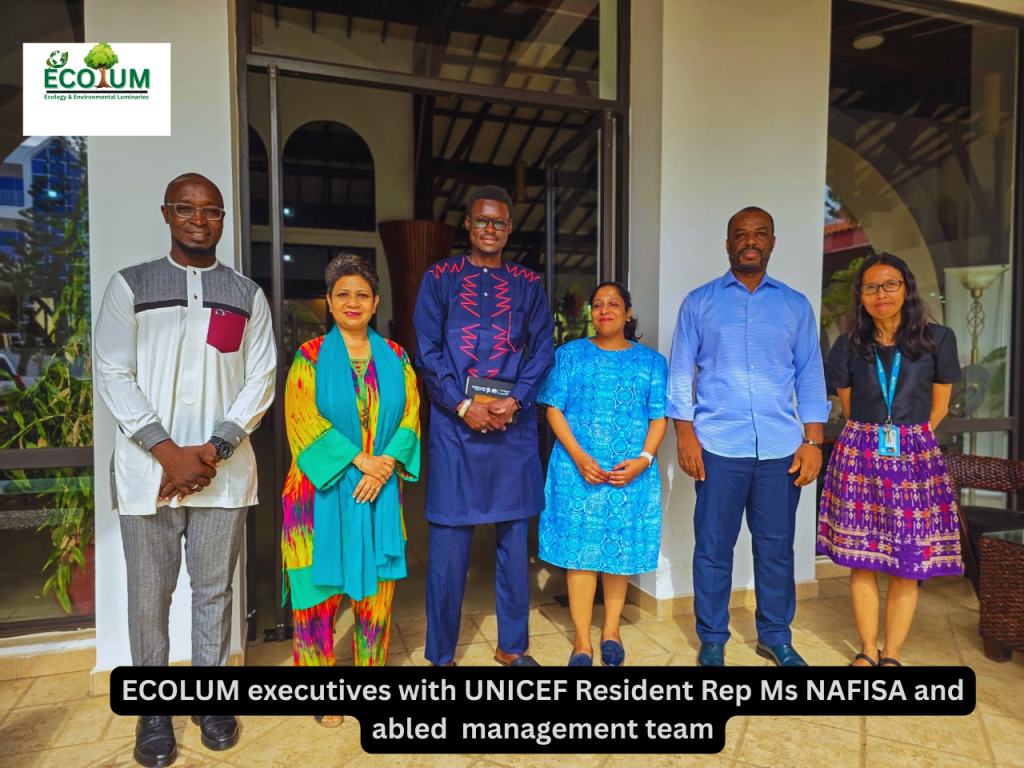
Earlier this week, the ECOLUM leadership, led by our Executive Director Hon. Abdoulie Njai and accompanied by our Communications Director, Mr. Amadou Wurry Jallow, held a fruitful and insightful meeting with Ms. Nafisa Binte Shafique, UNICEF’s’ Country Representative to The Gambia, and her distinguished team.
This long-awaited engagement was truly worth the wait, offering an opportunity to explore areas of collaboration where ECOLUM and UNICEF can jointly contribute to The Gambia’s national priorities while strengthening child-centered, climate-resilient development.
Our Shared Priorities for Collaboration
1. Education
Together, we recognize the importance of embedding climate and environmental literacy into formal and informal education systems. ECOLUM brings expertise in youth-led programs and school-based awareness initiatives, complementing UNICEF’s mission to empower children with knowledge and skills that prepare them for a sustainable future.
2. Policy & Advocacy
ECOLUM’s policy engagement rooted in both parliamentary experience and grassroots advocacy offers a strong foundation for evidence-based reforms that prioritize children, youth, and vulnerable communities. Working with UNICEF, we aim to strengthen child-sensitive climate and social policies, ensuring national frameworks remain aligned with international agreements such as the SDGs, UNFCCC, and UNCCD.
3. Research & Data
Reliable data is central to good governance and effective interventions. ECOLUM is committed to supporting UNICEF’s agenda by building local research and data systems that generate credible, disaggregated information on the intersection of environment, climate change, and child welfare. This will ensure that programs and policies are driven by evidence rather than assumption.
4. Community Empowerment
ECOLUM has a strong track record in grassroots mobilization. We look forward to co-developing initiatives that empower women, youth, and local communities with climate-smart livelihoods, enhanced resilience to environmental shocks, and active participation in development planning. This approach aligns with UNICEF’s commitment to equity and inclusion.
5. Partnership Expansion
Our conversation with UNICEF underscored the importance of multi-stakeholder collaboration. ECOLUM stands ready to work hand-in-hand with UN agencies, government institutions, civil society, and international partners to ensure sustainable impact at both community and national levels.
Looking ahead, ECOLUM is honored to be considered as a prospective partner in development by UNICEF Gambia. We reaffirm our unwavering commitment to playing an integral role in advancing the areas discussed, and to extending our support to any additional projects where our expertise and innovation may add value. We believe partnerships are the cornerstone of sustainable impact. This meeting with UNICEF has renewed our vision of building bridges that bring together climate action, governance, and human development under one shared goal: ensuring no child is left behind in the journey toward a sustainable and just world.Together, these inputs solidified our shared conviction: that development outcomes must be climate-smart, child-centered, and future-oriented.