
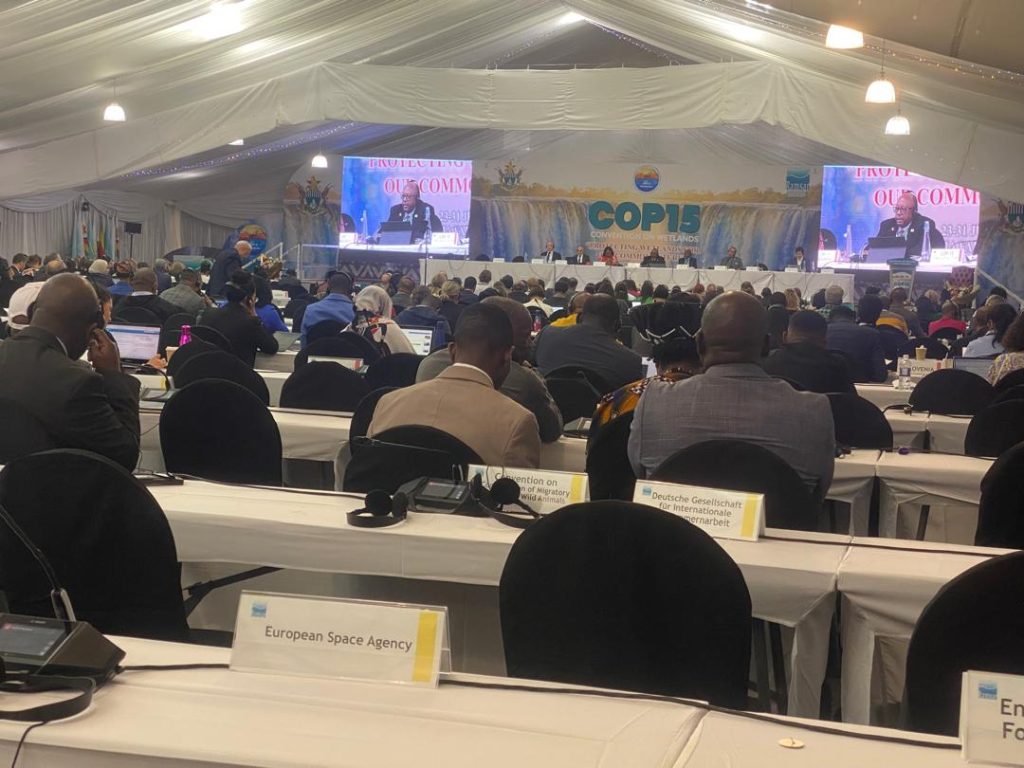
As Ramsar COP15 unfolds in Victoria Falls, Zimbabwe, the urgency in the air is not just ecological it’s moral. This is not another ceremonial gathering for well-worded communiqués. It is a front-row seat to the slow collapse of the world’s most vulnerable ecosystems, and a test of whether the global community especially developed countries will finally wake up to what frontline communities have known for years: that wetlands are not just biodiversity havens; they are life systems holding our climate, economies, and food chains together.
At ECOLUM, we are on the ground. And what we see, hear, and experience daily is a continent brimming with solutions, not helplessness. Communities across Africa and the Global South are already adapting, regenerating, and innovating using traditional knowledge, low-tech restoration, youth-led action, and cooperative resource governance. But the truth remains: we are fighting a global battle with local tools and no structural support.
It’s time the Global North stopped responding to climate collapse with charity. We don’t want help. We want partnerships—equitable, transparent, and rooted in mutual respect. Wetlands are disappearing three times faster than forests. Global emissions and overconsumption patterns are primarily driven by developed economies, yet those bearing the brunt through droughts, floods, food insecurity are least responsible. This reality demands more than acknowledgment; it requires real redistribution of responsibility and resources.
Ramsar COP15 cannot be remembered as another technical conference with pretty language and post-event silence. Developed countries must not come to such spaces with pre-packaged solutions or symbolic pledges. We don’t need external experts to teach us how to manage wetlands. We need access to climate financing, to restoration technology, and to global decision-making tables where our innovations and voices are taken seriously.
ECOLUM’s mission has always been rooted in this truth: local solutions are essential to the global climate fight. Our communities are already restoring degraded wetlands using community-based models. Our youth are building awareness and pioneering green innovations in energy, farming, and conservation. Our legislative advocacy is strengthening accountability frameworks at the national and sub-national levels. But the scale of this crisis demands that such efforts are uplifted not isolated.
To developed countries: COP15 is your opportunity to demonstrate integrity. Enough of the extractive models of development that commodify nature and discard people. Enough of financial commitments that never materialize. And enough of dominating climate narratives while excluding those living closest to the frontlines.
Partnerships must be designed differently. Not donor-recipient. Not consultant-client. But collaborators working side by side to design, implement, and scale context-driven solutions. Global conservation policy must reflect ecological realities on the ground, not institutional preferences in boardrooms.
ECOLUM is committed to building those bridges between policymakers and people, between science and tradition, between local innovation and global policy. We are not waiting for permission or perfection. We are acting now. But we will not stand silent while the burden of action continues to fall disproportionately on those with the fewest resources.
As COP15 continues, the world has a choice: will it continue the cycle of polite inaction, or will it finally confront the uncomfortable imbalance at the heart of climate governance?
Wetlands don’t need our speeches. They need our solidarity. The communities protecting them don’t need saving. They need standing with.
Let this COP be the one where developed nations stop offering sympathy and start offering seats at the table—and shared responsibility on the ground.
Issued by ECOLUM (Ecology & Environmental Luminaries)
Victoria Falls, Zimbabwe | Ramsar COP15 | July 2025